

I was always under the impression there were only two ways to feed a baby: exclusively breastfeeding or formula bottle feeding. After getting pregnant, I learned exclusively pumping and bottle feeding breastmilk was also a primary feeding option.
There is also the unique (and exhausting) hybrid of all three. This post is all about combo-feeding twins from birth through three months.
Ultimately, I want to bring awareness to the non-exclusive feeding options that don’t fit into the either/or boxes.
what the what is combo-feeding anyway?
Combo-feeding is just like it sounds, feeding your baby both breastmilk AND formula as a way to ensure baby is getting enough nutrients.
This includes but its not limited to: topping off a nursing session with a small bottle of formula, nursing for one feeding and bottle feeding formula for another, or pumping and switching off bottles with breastmilk and formula.
Note: it is not recommended you mix powdered formula with breastmilk in lieu of water
why would a mama need to combo-feed?
The simple answer is by choice or by circumstance.
I was personally in the circumstance category. I was not well-supported in my breastfeeding journey. Due to complications after birth, fear mongering by medical staff, and a lack of confidence in myself, my body was never given the chance to supply for the demand because the demand was lessened by the crutch of formula.
Whether it’s by choice or because your body isn’t producing enough milk (which is most common in multiple births), however you choose to feed your baby is your business.
Unless you put it on the internet like me… haha
how i got started combo-feeding
Initially, supplemental feeding was offered to provide support while my milk came in.
Having a c-section can sometimes delay milk production when the body doesn’t go through labor, which was my case. I also suffered significant blood loss which caused complications leading to multiple blood transfusions. This made it more difficult for me to attempt breastfeeding.
We were asked to choose either formula or donor breastmilk.
It bares mentioning that I was never asked if I wanted to supplement. I was just asked to make the choice of what would be used. There was no conversation around why, or for how long.
Still coming down from my surgery medication and suffering significant blood loss, I chose donor milk hoping to exclusively breastfeed.
I was provided a pump but not a lot of instruction on how to use it.
In the post-op room, the boys were placed on me to “nurse” and were left there for over 45 minutes with a bad latch. My nipples were cracked and bleeding afterward which made it even more difficult to continue on top of everything else.
Every nurse, doctor, or lactation specialist I saw had different advice from the one before, along with family members providing their two cents.
Among all the noise, I continued to nurse as often and as best I could while pumping until my nipples were four times their normal size.
I was eventually able to get that liquid gold to drop and I was on cloud nine.
We received no instruction on what to do once we left the hospital in regards to supplementing. It wasn’t until I brought up where I could get donor milk that they told me it was difficult to get and expensive.
Not knowing any better, my husband went out to purchase formula after dropping me and the boys off at home and our combo-feeding life had begun.
If I sound a little bitter about it, it’s because I am. But that’s a story for another time.

building a combo-feeding routine
In the beginning, it’s going to feel like all you do is make milk and feed your babies.
My combo-feeding routine wasn’t just nurse/top off bottle. I nursed each boy individually and included a pumping session afterward.
I always had an extra set (or two) of hands around to help so I never gave bottles.
Having the extra set of hands was great, but I was also never forced to figure out how to do it myself. I probably could have cut the hour-long (I’m not joking) process in half if I had focused on tandem nursing and gave bottles.
Safety Warning: powdered formula is not recommended for newborns under 2 months due to possible exposure to botulism, and warmed liquid formula should be given instead.
At first, I was only offering a couple of ounces of formula to “top off.”
While nursing Twin 1, someone would start heating bottles in the warmer. The first bottle would be done warming by the time I finished with Twin 1, and the process would repeat for Twin 2.
This method required at least two people to run smoothly.
Once the boys turned two months, we switched to powdered formula and started using the Baby Brezza. It streamlined the process because we could make both bottles in less than a minute.
our overnight routine
I exclusively breastfed overnight.
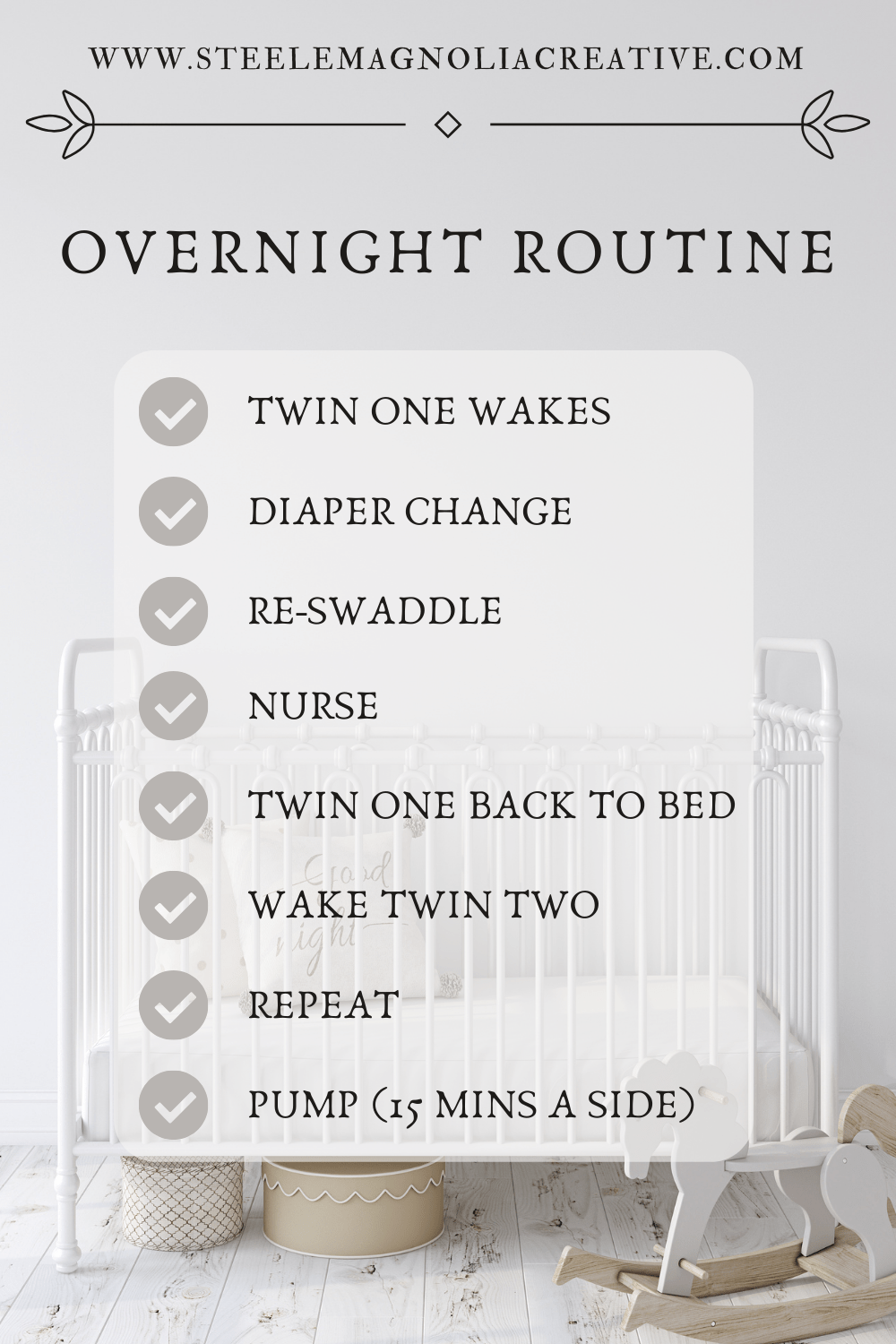
Around the four-hour mark, one of the boys would stir. I would quietly get him up, change his diaper, re-swaddle, nurse him, and put him back in his bassinet to go back to sleep. Then I would gently wake the other twin and repeat the process.
Waking the second twin ensured that I got solid chunks of sleep because they were running on the same schedule.
By some miracle, they rarely woke up together and went back down quickly, so I could do this entirely on my own.
After I got them both back in their bassinets, I would stay up to pump. I would do at least 15 minutes on each side, one side at a time. It was just easier than trying to mess with the pumping bra in the middle of the night.
The entire process took about an hour and would repeat usually every four hours.
Quick Tip: if pumping one side at a time, use one flange for both sides. The second flange stays clean for the next pumping session. Save the washing for the morning and get some extra sleep.
pumping and combo-feeding
Pumping is not required for a successful breastfeeding journey but can be a handy tool.
If you are exclusively breastfeeding, offering a bottle of breastmilk once in a while helps get them used to taking bottles which in turn frees you up for some self-care.
Pumping also helps stimulate milk production. There are quite a few articles on Pinterest about pump cycling to optimize production.
I started out pumping after every nursing session, even overnight. However, the pumping sessions were not bearing much fruit, which was discouraging.
Pumping PSA: the amount of pumped milk after feeding is not an accurate indicator of supply. A baby with a good latch can drain a boob dry in no time flat, and milk production is not an instant gratification situation.
If I had enough pumped milk on hand, I would offer that instead of formula as a top-off, but only if I had enough for both boys.
Combo-feeding my twins in the newborn months was not the way I planned to start out motherhood.
Whatever way you choose to feed your babies is the right way. It also doesn’t have to stay the same.
We made significant changes to how we fed the twins in month four. Stay tuned!